Blog

  • How Fully Automated Trading Systems Operate in the Forex Market

    How Fully Automated Trading Systems Operate in the Forex Market

    Forex trading is a huge market. Way bigger than most people might think. In fact – the market sees around $9 trillion a day traded five days a week, every week. Although the majority of people still trade manually, or with the help of guided systems, people are increasingly turning to automated trading systems or bots to do the hard work for them. In fact, estimates are a third of global forex trades are now placed automatically. To those new to the game this might sound like a money making machine. But is it really? 

    These automated systems can trade without emotion or sleep, and they can facilitate trades instantly without manual input or fear of slow responses or misclicking. However, they’re only as good as the inputs that made them and they do need some tweaking to keep up if there are dramatically changing market conditions. If not, when things go wrong they go can wrong but faster. Nevertheless, forex trading software has been a revolution for many traders and they can work wonders in some circumstances. 

    What these Systems Can and Can’t Do 

    Automated forex trading systems are not AI bots that replace the role of a trader. However, they are very good at being constantly online and monitoring market graphs to place trades at set conditions or times. 

    Waiting for some big news announcement to drop and you think you can get in before the market reacts, but it’s not in your time zone? Easy, just set up your forex auto trading software to make the trade at the time of the scheduled announcement. 

    The above is called trend watching, but other forex strategies can also make good use of automated software. Arbitrage – which is a lot harder to do today than it was – is basically only possible at scale using automated bots, as any trading platform pair discrepancies are usually fixed with milliseconds on the modern market. Scalping can also benefit from automation as it makes it infinitely easier to place dozens or even hundreds of small trades at once. 

    However, automated systems cannot react to market news before it hits currency prices. They can look at signals within forex graphs, but monitoring global geopolitical and economic events in real time is not something they can do (yet). Traders can combine automated platforms with generative AI research to quickly identify and parse significant news stories and then update their trading algorithm for the new conditions. 

    How Automated Systems Make Trading Decisions (An Overview)

    Automated forex trading software is not (yet) AI-powered agents. Instead, traders or the software creators manually set up the software for certain tasks and conditions. The software has some ability to make its own decisions in set parameters – however these are all based on math, not judgements of external market factors. 

    The list of input parameters for a top trading bot will be extensive, but some of the options you’ll see regularly include:

    • Price movements
    • Stop-loss levels
    • Take-profit level
    • Currency pairs
    • Risk limits
    • Maximum open trades
    • Position size

    Traders can set their own values for any of these or set up a couple and let the bot deal with the rest. The best traders will make use of almost all options available, and regularly return to the automation system to tweak their choices. 

    Essentially, traders make the decisions and bots just execute them when pre-set market conditions or timings line up. Automated software can both open, close and manage hundreds of trades at once and they can run precisely 24 hours while markets are open. 

    Pros, Cons and What Makes Them Popular 

    The answer to why automated forex trading is popular is quite self explanatory. The promise of setting up a trading bot that can make passive income while the trader does other things with their time is something many people can’t ignore.

    But the reality is, the set up takes some time and knowhow. A novice trader with a bot will just make the same mistakes but faster. However, for an experienced or professional trader automated systems can be huge. 

    On the plus side these trading systems are fantastic because:

    • They trade far faster and infinitely longer than a human could do manually, which is essential for some strategies
    • They don’t get tired and make bad judgements like impulse panic selling – they stick to the plan even if things look dicey
    • They can multiple markets at once
    • They never get the math wrong 

    On the flipside, trades have to be aware they are not automated money printers. Without a reasonable amount of monitoring and updating, automated trading systems can make bad trades if market conditions change and they’re not set up for it. 

    The reality is however, a lot of professional traders now use automated systems day in and day out. With up to a third or more of the trillions of dollars of daily global forex trades now automated, fully manual traders risk getting left behind. 
  • The Economics of Investor Confidence: Why Venture-Backed Startups Still Print Pitch Decks

    Silicon Valley is fueled by digital ingenuity, but the founders of tech companies have been known to walk into offices on Sand Hill Road with printed pitch decks. Outsiders are baffled by this contradiction, but venture capitalists know something fundamental about human psychology and decision making.

    Physical materials are processed by the brain differently than screens, and when you’re going after millions in funding, any edge helps.

    What happens during a typical VC pitch that makes printed materials valuable?

    Partner meetings at firms like Sequoia or Andreessen Horowitz are sessions during which dozens of companies are reviewed each week by four to six decision makers. A founder has 20 minutes to present, then partners talk without the entrepreneur. 

    Printed decks remain in the room during such deliberations, occupying the surface of a conference table as if to serve as a physical reminder, whereas digital presentations vanish when laptops are snapped closed.

    Even smart founders rely on more than their two minutes in the spotlight. They create printed leave-behinds, distributed at the evening receptions to ensure their company remains top-of-mind when investors read back through their notes after the event.

    With services as HelloPrint, startups are able to easily generate professional booklets on the cheap and quick, essentially turning pitch decks into bound presentations that potential investors can pull from a mass of business cards and one-pagers.

    How do Series A and B fundraising dynamics differ from seed rounds?

    The first seed rounds are the beginning for you to meet with angel investors who seen your products, and this could change everything. You now have access to institutional investors who want to know about your company’s financial projections, market analysis, and team background.

    In these meetings, you will meet analysts who were not present at the original pitch, associates whose job it is to write investment memos, and partners who then have to compare your opportunity with those of their entire portfolio.

    Printed matter is for selling you after you leave. If a junior partner is pitching your startup in partnership meetings on Monday, it helps them to make your case properly, if you have well-structured materials.

    Why do some of the most digital-forward companies still use physical pitch materials?

    It’s really not shocking when a SaaS company that offers cloud based solutions hands out printed booklets. But there’s a behavioral economics explanation for this. Investors are bombarded by 100s of pitch decks every month over email. The vast majority are skimmed for 90 seconds and then deleted. 

    Physical documents produce what psychologists call the “endowment effect,” which is that possessing a physical object makes people value it more. An investor with your printed deck has physically invested more attention than someone reading a PDF.

    Senior partners at most big funds are 50+ managers who made their careers before smartphones existed. And many still like to review potential investments outside of a screen, jotting notes in the margin or during their commute, or reading and reviewing after work at night.

    If you respect the choices made by your audience, then it requires that they be met on their own terms, not yours. That is why tech companies still print booklets for investor meetings even when all they build is digital.

    What specific elements make a pitch deck work and how can HelloPrint help?

    Laying out packets of pages across a conference table allows investors to compare year-to-year growth, unit economics and cash flow at the same time. Linear time In a digital presentation, progression through the slides is linear in time, which makes it difficult to recognise patterns.

    Consistency of brand is more important than founders think it is. Your pitch deck shows your company’s level of detail and professionalism. Cheap printing with crooked pages or weak color reproduction betrays the message you’re trying to communicate about the quality of your product. Professional print helps ensure that your materials are a reflection of the caliber you’re promising investors. 

    Through HelloPrint, startups can choose from saddle-stitched booklets for a casual meeting to perfect-bound presentations for the more official board-pitch moments, allowing you to tailor your materials to each round of fundraising.

    Does the format of investor materials actually influence funding outcomes?

    Correlation is not causation, but venture capital is based on pattern recognition and nuances. Founders who invest in quality presentations are signaling their understanding of a professional level and also attention to detail.

    The answer is probably multi-factorial. Print shows commitment and seriousness about the relationship. They make it easy for investment opportunities to be reviewed internally by your investors. They form a material distinguisher in the pile of generic PDF attachments.

    Above all, they demonstrate that you know money-raising is a game of human psychology, not just spreadsheet analysis. The most successful founders think of fundraising as relationship building, where physical materials play into their strategy to build that connection.

  • Why traditional stock heatmaps fall short in market analysis

    Why traditional stock heatmaps fall short in market analysis

    For investors, analyzing hundreds of stocks simultaneously is a daily challenge. We often rely on stock heatmaps to quickly get an overview of the S&P 500, Nasdaq 100, or the Dow 30. But most tools we use have a fundamental design problem: they don’t adapt to what you actually want to see.

    The problem with static visualizations 

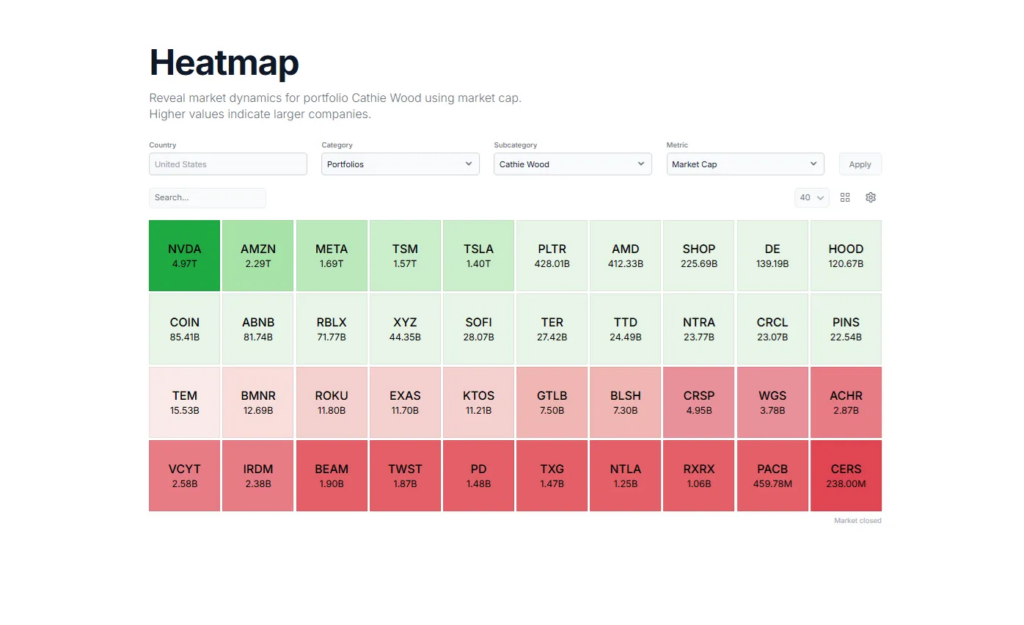
    Traditional stock heatmaps use one fixed layout for all metrics. When viewing by market capitalization, companies like Apple, Microsoft, and Nvidia always dominate the screen, which makes sense. But here’s where things become problematic.

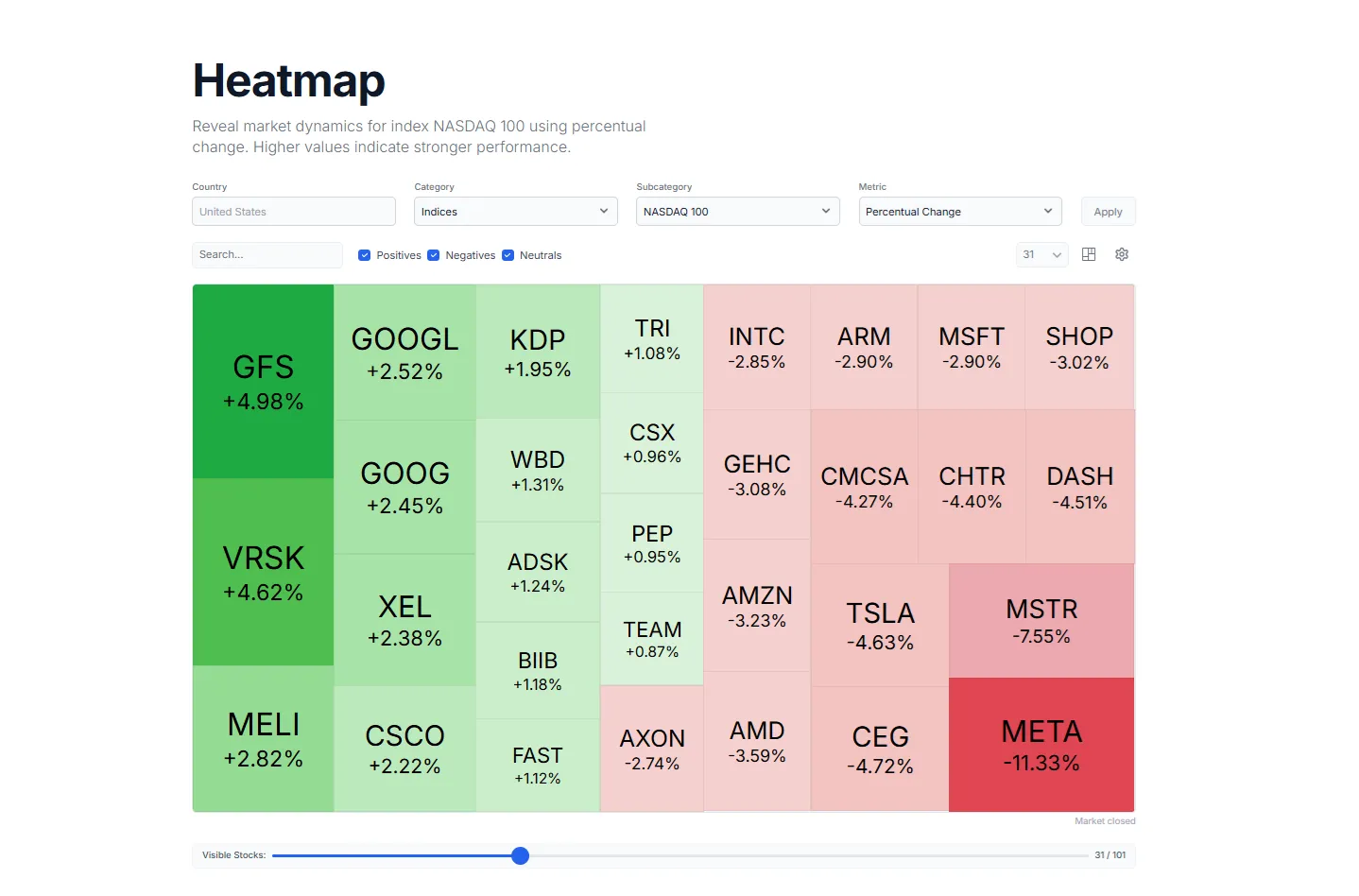
    When you switch to price change, the layout stays exactly the same. A company with a $3 trillion market cap still occupies most of your screen, even if its price has barely moved. Meanwhile, smaller companies with spectacular price movements get pushed into the tiniest corners of your screen. You systematically miss the signals that matter most for your analysis.

    This forces investors to figure out what they’re missing. It costs time, burns energy, and leads to missed opportunities.

    The Marketgenius solution: dynamic layouts that adapt

    Marketgenius solves this with stock heatmaps that automatically adapt based on the selected metric. Instead of forcing data into a static layout, the visualization reorganizes itself in real-time based on what you’re analyzing.

    When you filter on price change with these dynamic layouts, stocks with the strongest movements automatically get the most space. Switch to PEG ratio and value stocks dominate the screen. This principle, where the visualization serves the data instead of the other way around, makes patterns and outliers immediately visible.

    Follow the superinvestors: Warren Buffett, Cathie Wood, and Carl Icahn

    This is where it gets even more interesting. Marketgenius lets you track the portfolios of superinvestors like Warren Buffett, Cathie Wood, and Carl Icahn in real-time using the same dynamic stock heatmaps. Immediately see which stocks these investors are buying and selling, visualized with the same power as major indexes.

    This insight was previously only accessible by searching through SEC filings for hours. Now you get it presented in a clear, interactive visualization. Want to see how Buffett’s portfolio performed over the past quarter? Or which tech stocks Cathie Wood is adding? It’s just one click away.

    Practical benefits for investors

    Flexibility: Adjust the interface to what you find important. Filter to show only positive changes, negative changes, or specific metrics that matter to you and display the results as a heatmap, block diagram, or table.

    Mobile optimized: Finally, an interface that actually works on your phone. Built with the latest technologies for speed and optimal mobile use. Say goodbye to old desktop applications crammed onto your mobile screen.

    Faster analysis: No assumptions needed. Heatmaps that work like the human brain: visual recognition makes patterns, outliers, and trends jump out immediately.

    Contextual information: Integrated explanations of financial terms, risk indicators, and peer comparisons make it accessible even without a financial background, helping you make informed investment decisions faster.

    Diversity: Explore major indexes (S&P 500, Nasdaq 100, Dow 30) alongside superinvestor portfolios and more.

    Conclusion

    For investors who trade stocks, it’s time to look beyond traditional static heatmaps. Dynamic visualizations that adapt to your analysis needs, combined with the ability to follow superinvestors, make the difference between noise and relevant signals. In markets where every second counts, that’s not a luxury but a necessity.

  • How AI Forex Robots Are Transforming Automated Currency Trading

    How AI Forex Robots Are Transforming Automated Currency Trading

    Artificial intelligence is reshaping how currency trading decisions are made in real time. Automation now influences discipline, speed and risk control across global forex markets, allowing strategies to operate continuously without emotional interference or fatigue affecting execution.

    Foreign exchange trading now operates inside a data-driven environment shaped by automation. Algorithms react to market changes faster than manual decision-making allows, processing price movements, liquidity shifts and volatility signals within milliseconds across multiple currency pairs.

    This evolution is changing how traders think about control, timing and consistency. Decision-making is increasingly delegated to systems designed to follow predefined rules, helping reduce impulsive behavior while maintaining steady performance during rapidly changing market conditions.

    Automation Moves From Convenience to Core Infrastructure

    Automation in forex trading is no longer a side tool. It has become core infrastructure. Early bots handled repetitive execution. Today’s systems analyze market structure, liquidity shifts and volatility cycles together.

    This change matters because forex markets move continuously. Asia, Europe and North America overlap. Price behavior shifts with each session. Manual strategies struggle to maintain focus across these transitions.

    AI-driven systems stay active without fatigue. They monitor conditions during quiet ranges and sudden breakouts. That constant awareness changes how opportunities are captured. It also changes how losses are limited.

    Global forex turnover exceeds $7 trillion per day, based on BIS reporting. Speed and scale now define relevance.

    Learning Models Replace Static Trading Logic

    Rule-based bots followed fixed instructions. Those rules worked until conditions changed. Ranging markets, unexpected news and liquidity gaps often broke those systems.

    Modern models learn from evolving patterns. They track how price reacts to volume, time and volatility together. This approach improves context awareness. In the middle of this shift, the AI forex trading robot has become a system built around adaptation rather than repetition. That distinction separates modern automation from earlier tools.

    Two or three lines of context matter here. Currency markets repeat behaviors, not exact movements. Learning models search for probability structures. This allows strategies to adjust rather than fail silently.

    The result is fewer forced trades and better alignment with prevailing conditions.

    Execution Speed Changes the Nature of Opportunity

    Execution speed shapes outcomes in forex trading. Minor delays increase slippage and missed entries. AI systems process signals and send orders in milliseconds.

    That speed matters most during volatility spikes. Economic releases often move prices sharply within seconds. Automated execution reacts instantly without hesitation.

    Key execution advantages include:

    • Faster response to breakout confirmation
    • Consistent entry logic across sessions
    • Reduced emotional delay during drawdowns

    These improvements do not guarantee success. They reduce friction. Lower friction means strategy performance reflects logic rather than reaction time.

    Risk Control Becomes Structured and Predictable

    Risk management defines survival in forex trading. AI systems enforce predefined limits without emotion. Position size adjusts automatically based on volatility and account exposure.

    Drawdown protection plays a critical role. When losses exceed thresholds, trading pauses. This prevents emotional overtrading after setbacks. Correlation logic also matters. Exposure across related pairs adjusts dynamically.

    For example, EUR-based pairs often move together during macro-driven sessions. Automated systems recognize that overlap. Aggregate risk stays controlled even when multiple signals appear.

    This structure creates consistency. Trading becomes a measured process instead of a reactive cycle.

    Transparency Improves Confidence in Automation

    Automation raises trust questions. Decision logic must be visible. Many modern systems now provide detailed execution logs. These records show why trades triggered and how parameters changed.

    Transparent reporting supports accountability. Trade histories outline entry conditions, exit logic and risk calculations. This transparency allows evaluation without blind reliance.

    Confidence also depends on realistic framing. Sustainable systems focus on probability management. Short-term performance spikes mean little without long-term stability.

    Trust grows when systems clearly explain their actions and avoid exaggerated expectations.

    Human Oversight Still Shapes Outcomes

    Automation does not eliminate human responsibility. Oversight remains essential. Strategy selection, risk tolerance and performance review still require judgment.

    Successful traders monitor system behavior regularly. Reviews focus on drawdowns, trade frequency and session performance. Adjustments occur at the strategy level, not during live trades.

    This division of labor matters. Machines handle execution and discipline. Humans handle objectives and risk boundaries. That balance reflects how automation functions across modern financial markets.

    Market Structure Adapts to Intelligent Systems

    The spread of AI-driven trading changes the market structure. Liquidity reacts faster. Inefficiencies close more quickly. Competitive advantage now depends on adaptability.

    Static strategies lose relevance faster in this environment. Systems that adjust survive longer. Retail traders gain access to tools once limited to institutions.

    Regulators continue monitoring automation trends. Execution fairness and transparency remain priorities. System design increasingly reflects compliance alongside performance.

    A Shift Toward Process Over Prediction

    AI-driven forex trading does not remove uncertainty. It reframes how uncertainty is managed. Speed, discipline and adaptability now matter more than prediction.

    The market still surprises. Automation does not prevent losses. It reduces impulsive behavior and execution errors. That difference compounds over time.

    For traders, the focus shifts toward preparation and review. Automated systems reward structure and patience. In a market defined by constant motion, process often matters more than precision.

  • XRP rose 10% during the bull market, and investors in Blackchain  Mining also earned $8,777 in profits every day

    XRP rose 10% during the bull market, and investors in Blackchain  Mining also earned $8,777 in profits every day

    As the cryptocurrency market continues to heat up, XRP has seen a strong surge in recent bullish trading, with its price soaring by 10% in just a few days. This increase not only reflects investors’ confidence in the future development of digital assets but also further highlights the crucial role of professional investment platforms in generating returns in the market. During this rally, investors on Blackchain Mining have performed exceptionally well, achieving an average daily return of $8,777 thanks to the platform’s efficient computing power and intelligent management, providing investors with stable and substantial profit opportunities.

    What is Blackchain Mining?

    Blackchain Mining is a pioneering platform offering a one-stop investment service for cloud mining. While cryptocurrency mining can be profitable, beginners often face challenges such as the required effort, the technical skills needed, and the high cost of equipment.

    Users choose a suitable mining package on the Blackchain Mining platform, and the platform allocates the purchased computing power to a mining pool it manages. Once allocated to a pool, your computing power works with other miners to mine cryptocurrency. Users simply wait for their earnings.

    Blackchain Mining’s core advantages:

    Registration Reward: Receive $18 upon registration (can be used for daily check-ins, earning $0.72 profit per day)

    Affiliate Program: Receive up to 5% referral rewards upon joining

    Daily Settlement, Flexible Withdrawal: The platform automatically calculates your earnings daily. You can conveniently and flexibly withdraw your balance at any time.

    Global Asset Insurance: Platform assets are insured with Lloyd’s of London, providing global protection for customer funds.

    Flexible mining options: The platform offers a variety of mining contracts, from small-scale trials to high-end customized solutions, to meet the needs of investors with different capital sizes.

    Examples:

    New User Experience Contract: Investment: $100; 2 days, Total Net Profit: $100 + $6

    Antminer-T19: Investment: $500; 6 days, Total Net Profit: $500 + $40.5

    Avalon Miner-1466: Investment: $1100; 12 days, Total Net Profit: $1100 + $184.8

    Whatsminer-M60: Investment: $2600; 16 days, Total Net Profit: $2600 + $603.2

    Whatsminer-M60S+: Investment: $5300; 20 days, Total Net Profit: $5300 + $1590

    Antminer S21 XP IMM: Investment: $9700; 27 days, Total Net Profit: $9700 + $4190.4

    (The platform offers various stable yield contracts, which can be viewed on the Blackchainmining website.)

    Why are more and more people trusting BlackchainMining?

    BlackchainMining is a legitimate, secure, and trustworthy cryptocurrency cloud mining platform dedicated to enabling global users to obtain stable digital asset returns with low barriers to entry.

    As a professional cryptocurrency platform, we serve users worldwide, offering 100% risk-free, 100% profitable, 100% transparent, and 100% secure contracts.

    Our mission is to provide every user, whether a novice or experienced investor, with a seamless and intelligent cloud mining investment experience, allowing you to focus on returns without worrying about equipment, technology, or complex operational issues.

    Conclusion

    XRP’s 10% rise during the bull market not only signifies the activity of the digital asset market but also provides substantial opportunities for professional investors. BlackChainMining, with its efficient computing power, intelligent management, diversified products, and secure fund guarantees, enables investors to easily capitalize on market trends and achieve a stable daily return of $8,777. For those seeking long-term profitability in the cryptocurrency market, choosing BlackChainMining is undoubtedly a wise path to wealth growth.

    Official Website: blackchainmining.com

    Email Address: info@blackchainmining.com

  • How Strong Corporate Leadership Drives Stock Performance

    We spend a lot of time obsessing over quarterly earnings reports, P/E ratios, and market trends when we try to figure out why a stock moves the way it does. But beneath the cold, hard numbers lies a variable that is much harder to quantify yet infinitely more impactful: the people sitting in the C-suite. The connection between strong corporate leadership and stock performance isn’t just correlational; it’s often the primary driver of value creation.

    When you buy a share of stock, you aren’t just buying a piece of a product or a revenue stream. You are effectively betting on a management team’s ability to handle uncertainty. Think about the last time a major CEO stepped down unexpectedly. The market usually reacts instantly, often violently. Why? Because investors know that a ship without a captain, or worse, with an incompetent one, is prone to drifting, no matter how strong the wind is.

    The Visionary Factor

    Great leaders do more than just manage the status quo; they see around corners. This is the “visionary factor.” It’s the difference between a company that merely survives a technological shift and one that defines it.

    Consider the tenure of Satya Nadella at Microsoft. Before he took the reins, the tech giant was seen by many as a legacy player, stuck in the PC era while mobile and cloud computing raced ahead. Nadella didn’t just tweak the strategy; he overhauled the culture. He shifted the focus from “know-it-all” to “learn-it-all.” The result? A massive pivot to Azure and cloud services that propelled the stock to stratospheric heights.

    This kind of leadership requires a mix of hard skills and deep emotional intelligence. It’s about convincing thousands of employees to row in the same direction even when the destination isn’t entirely visible. When a CEO can articulate a clear, compelling future, Wall Street tends to listen, and more importantly, buy in. The stock price becomes a reflection of faith in that narrative.

    Operational Excellence and Crisis Management

    Of course, vision without execution is just hallucination. Strong leadership is also about the gritty, unglamorous work of operational excellence. It’s about making difficult calls on capital allocation, deciding whether to buy back shares, acquire a competitor, or invest in R&D.

    We saw the flip side of this during the 2008 financial crisis and, more recently, the post-pandemic supply chain crunches. Companies with robust, decisive leadership teams managed to secure inventory and maintain margins, while those with weaker governance floundered. Investors flock to stability during turbulent times. If a CEO demonstrates they can keep the lights on and the profits flowing when the world is on fire, the stock usually commands a premium valuation.

    This level of strategic thinking is rarely accidental. It is often the product of rigorous advanced education and lifelong learning. Many top executives are increasingly turning to specialized doctoral degrees to sharpen their decision-making frameworks. It’s not uncommon to find leaders pursuing online Ed D programs to deepen their understanding of organizational change and complex problem-solving without stepping away from their demanding roles. This commitment to continuous intellectual growth often translates directly into smarter, more resilient corporate strategies.

    Culture as a Leading Indicator

    There is a softer side to this equation that analysts often miss: corporate culture. A toxic culture is a ticking time bomb for stock performance. We’ve seen plenty of high-flying startups crash back to earth because their internal culture was rotten, leading to talent exodus, scandals, and regulatory crackdowns.

    Conversely, strong leaders build cultures of accountability and innovation. When employees feel safe to take risks and are rewarded for performance, the company innovates faster. This internal health eventually shows up in the external financials. You can almost feel the difference when listening to earnings calls. Is the CEO defensive and vague? Or are they transparent, acknowledging failures while outlining the path forward?

    Investors are getting smarter. They are looking at Glassdoor ratings and employee retention rates as leading indicators of future stock performance. A CEO who ignores the human element does so at the peril of their shareholders.

    The Long Game

    The market is a weighing machine in the long run, and it weighs the quality of decisions made at the top. Short-term stock pops can be engineered through financial engineering or hype, but sustained growth over a decade requires genuine leadership.

    It is about stewardship. The best leaders treat shareholder capital as their own, making decisions that might hurt the stock price today but will double it three years from now. That requires courage. It requires the ability to stand in front of angry analysts and say, “Trust the process.”

    So, the next time you are analyzing a portfolio, look beyond the balance sheet. Who is holding the wheel? Do they have the vision to see the future, the grit to handle a crisis, and the wisdom to build a lasting culture? If the answer is yes, the stock chart will likely take care of itself.

  • Trump uses cryptocurrency to increase his wealth: XRP may be the best-yielding investment in 2026

    Trump uses cryptocurrency to increase his wealth: XRP may be the best-yielding investment in 2026

    Trump’s relationship with cryptocurrency is undergoing a strategic shift. Through his family-backed project, World Free Finance (WLFI), his team is pushing for the regulation of cryptocurrencies and the legalization of stablecoins, highlighting the growing importance of digital assets in high-level strategy.

     Against this backdrop, the market is shifting towards mature assets with clearly defined use cases. XRP is seen as an ideal choice for 2026, combining yield potential with stability, thanks to its strengths in cross-border payments, institutional partnerships, and regulatory progress. As blockchain technology becomes increasingly integrated into global financial infrastructure, broader institutional adoption and improved liquidity could prompt a revaluation of XRP, thus providing structural opportunities for long-term investors.

    Participating in the XRP ecosystem through compliant cloud mining: CryptoEasily path to stability

    To enable investors to participate safely in the XRP ecosystem, CryptoEasily offers green cloud mining services. Users don’t need to own their own mining rigs or have complex mining knowledge—they simply purchase computing power to earn stable daily returns and achieve passive income. The platform provides a secure and reliable infrastructure for long-term XRP investors through compliant hosting plans and transparent billing mechanisms.

     Through CryptoEasily, investors can convert mining power into a cash flow-oriented participation in the XRP ecosystem. Within a compliant framework, this achieves a “hold and reap” model with long-term compounding effects, providing stable returns regardless of market volatility.

    About CryptoEasily: A compliant, secure, and transparent global platform

     CryptoEasily, headquartered in the UK, strictly adheres to the EU’s Crypto Asset Market Regulation (MiCA) and the MiFID II framework. This establishes a systematic compliance foundation for transparency, operational standards, and investor protection.

    The platform has passed audits and security certifications from multiple international authoritative organizations, including:

    • PricewaterhouseCoopers’ annual audits and certifications ensure transparency in finances and operations.
    • Digital assets are insured by Lloyd’s of London, providing world-leading custody insurance.
    • Employing Cloudflare enterprise-grade firewall and McAfee cloud security system, stability reaches up to 99.99%.
    • Cold and hot wallet separation and multi-layered encryption effectively prevent potential attacks.
    • An AI-driven real-time risk monitoring system identifies and blocks suspicious transactions around the clock.

     Currently, the platform supports deposits in major crypto assets and stablecoins such as USDT, BTC, ETH, XRP, and SOL, providing users with a flexible and efficient way to participate.

    The following three steps can help you start earning daily income:

    1. Register an account: Visit CryptoEasily and register with your email address to receive a $15 welcome bonus.

    2. Choose a mining package: Select from various cloud mining contract terms and start mining with one click.

    3. Earnings: After the contract is activated, the system will automatically distribute daily earnings, which you can withdraw or reinvest at any time.

    Common contract examples:

    • Newbie Plan:  The contract period is 2 day, the minimum investment amount is $100, and the total profit is $100 + $8
    • Basic Plan: The contract period is 5 days, the minimum investment amount is $500, and the total profit is $500 + $32
    • Stabilization Plan: The contract period is 25 days, the minimum investment amount is $10,000, and the total profit is $10,000 + $4,000

    [ For more contract details, please visit the CryptoEasily official website]

    conclusion

    XRP is increasingly becoming a core asset for institutional and private investors. CryptoEasily provides reliable access to the XRP ecosystem, offering green mining power and compliant custody services. Unaffected by market fluctuations, CryptoEasily daily automatic yield mechanism leverages compound interest to achieve long-term wealth growth – “holding guarantees a return.”

    Seize the potential investment opportunities in 2026. Combine the value growth of XRP in the digital finance era with the stable returns of CryptoEasily to lay a solid foundation for future wealth accumulation.

    [Click here to download the mobile app]

    Official website:https://CryptoEasily.com

    Email:info@cryptoeasily.com

  • What works for brain health supplements and how to choose

    The brain is a demanding organ, using up a surprising amount of the body’s resources every day. It’s no wonder that more people are looking into ways to support memory, focus, and mental energy as the years go by—often turning to products designed for cognitive support. With so many options out there, it can be tricky to know what actually works and how to pick the right products. Here’s a practical overview of the most talked-about ingredients, how they’re used, and what to look for when choosing supplements.

    Six ingredients that help sharpen your thinking

    When it comes to nutrients that support brain health, a handful stand out for their popularity and research backing. Omega-3 fatty acids, especially DHA, are well-known for supporting normal brain function and are often found in fish oil capsules or algae-based softgels. B-vitamins, particularly B6, B9 (folate), and B12, play a key role in memory and mental clarity. Vitamin D is another common pick, as low levels are linked to sluggish thinking. CoQ10 and its more absorbable form, ubiquinol, are sometimes used to support energy production in brain cells. Lecithin, a source of choline, is also included in some blends for its role in neurotransmitter production. For a deeper dive into these ingredients and their uses, see this helpful guide on supplements for brain health.

    How you can choose the right product

    Choosing between the many options for cognitive support can feel overwhelming, but a few key tips make the process easier. First, check the form and concentration of each ingredient. For example, omega-3s are best absorbed in triglyceride form rather than ethyl ester, and higher DHA content is often preferred for cognitive support. With B-vitamins, look for methylated forms (like methylcobalamin for B12) if possible, as these are more readily used by the body. CoQ10 is available as both ubiquinone and ubiquinol; the latter is generally considered more bioavailable, especially for older adults. Pay attention to the total milligrams per serving and whether the product uses standardized extracts. Some people prefer combination formulas that include several nutrients in one capsule, while others like to tailor their own mix. It’s also worth considering whether you want capsules, softgels, or powders, depending on your preferences and any dietary restrictions.

    Combining nutrients in your daily routine

    Many people find that combining certain vitamins for brain health gives the best results. A typical daily routine might include an omega-3 supplement with a B-complex and vitamin D, supporting everything from focus to mood. CoQ10 or ubiquinol can be added for those looking to maintain mental energy, especially if they’re over 40. Lecithin or choline is sometimes paired with these for extra support in neurotransmitter production. The reason combinations are popular is that the brain relies on a network of nutrients working together, rather than a single “magic bullet.” When choosing a routine, it’s important to consider personal needs, lifestyle, and any advice from a healthcare professional. For more on how different nutrients work together, see this resource on vitamins for brain health.

  • Building an Emergency Fund on a Modest Income

    Unexpected expenses do not care how tight your budget is. A flat tire, a lost shift at work, a sick pet, a higher heating bill in winter — any of these can throw off your month if every dollar already has a job. An emergency fund is simply a small pile of money that keeps those surprises from turning into credit-card debt or panic. 

    If you live on a modest income, saving “three to six months of expenses” can sound like a joke. The point, though, is to give yourself some breathing room. That might start with just $200 or $500. 

    Some people make room for that cushion by trimming banking costs first. For example, using fee-free options at local institutions such as Innovation Credit Union or choosing a no-fee chequing account so more of their cash can actually go toward savings instead of monthly bank charges. 

    What follows is a down-to-earth plan you can use even if you’re living paycheque to paycheque, with small steps that actually fit into a modest budget.

    What an Emergency Fund Really Is 

    An emergency fund is money set aside only for real emergencies: things that are necessary, urgent, and unplanned. Common examples include: 

    • medical or dental bills
    • essential car or home repairs
    • a sudden drop in income or job loss

    It’s not there for sales, vacations, gadgets, or regular yearly costs like back-to-school shopping. Those might be important, but they’re things you can usually see coming and plan for. 

    How much should you aim for on a modest income?

    Most official guidelines still recommend an emergency fund that covers about three to six months of essential expenses. That’s a great long-term target, but it’s not where you have to start. On a smaller income, it makes more sense to build your fund in stages so you feel wins early instead of giving up.

    A realistic path might look like this:

    • First milestone: $250–$500 – enough to handle a small repair or bill.
    • Next: $1,000 – covers many common emergencies.
    • Then: one month of bare-bones expenses (rent, groceries, utilities, transport).
    • Later: slowly grow toward three months, then more if your job or income is unstable.

    Thinking in milestones keeps the goal from feeling impossible. You’re just moving from one small level to the next.

    Step 1: Get Clear on Your Bare-Bones Expenses

    Before you decide what “one month of expenses” even means, you need a rough picture of your essential spending. This doesn’t have to be perfect or complicated. Look at a couple of months of bank or card statements and pull out only the non-negotiables:

    • housing and utilities
    • basic groceries
    • transportation to work or school
    • minimum debt payments
    • childcare or similar must-pay items

    Step 2: Park the Money Somewhere Separate

    When everything sits in one pot, it’s hard to tell what’s “spendable” and what needs to stay untouched.

    Use a simple savings account that: 

    • is separate from your main chequing account
    • has no or low monthly and transaction fees
    • lets you withdraw without penalties
    • pays at least a bit of interest

    Step 3: Start Tiny, Then Gently Increase

    Pick a weekly or monthly amount that feels almost too easy – something you can stick with without constantly pulling the money back out:

    • $5 a week becomes $260 in a year.
    • $10 a week becomes $520.
    • $20 a week becomes about $1,040.

    You can start with spare change transfers or rounding up purchases in an app, then bump it up when your situation improves or you free up a small bill elsewhere. 

    Step 4: Let Automation Do the Heavy Lifting

    Relying on willpower alone is tough when money is tight and bills are loud. Automation turns saving into the default, so you don’t have to make a fresh decision every payday.

    You can:

    • Set up an automatic transfer from your chequing to your emergency savings each time you get paid
    • Route a small part of your paycheque directly into savings if your employer allows split deposits

    Step 5: Make Space in a Tight Budget

    If your paycheque is already stretched, you may need to create room rather than waiting for extra money to magically appear. That usually means trading a few “nice but not essential” costs for the feeling of safety your fund will give you.

    Some realistic places to look are:

    • subscriptions you forgot about or rarely use
    • small upgrades you could roll back (for example, a cheaper phone plan or streaming bundle)
    • one or two takeout meals a month swapped for home-cooked food
    • small “treat” habits that add up, like daily coffees or regular delivery fees

    Step 6: Decide What Counts as a Real Emergency

    To protect your fund, it helps to have your own personal “emergency test” written down. Before you touch the money, ask yourself: 

    • Is this expense necessary for my health, safety, housing, or ability to work?
    • Is it urgent, or could I plan and save for it over a few weeks or months?
    • If I didn’t have this fund, would I need to use high-interest credit or miss a crucial bill?

    If the answer to all three is “yes,” your emergency fund is doing exactly what it’s meant to do. 

    What If You Have Debt as Well?

    If you’re carrying high-interest debt (like credit cards), it usually makes sense to build only a small emergency fund first, then switch your main focus to paying down that debt. Some agencies suggest building a cushion of about $500–$1,000 before attacking high-interest balances. 

    That way, you avoid the trap of paying off debt only to run it back up the first time something goes wrong.

  • A Smarter Way to Create Lease Agreements: How LegalDocs Helps You Get It Right

    A Smarter Way to Create Lease Agreements: How LegalDocs Helps You Get It Right

    A Comprehensive Guide to Lease Agreements

    In today’s fast-paced business environment, having the right legal documents ready when you need them is essential. Whether you are renting office space, leasing equipment, or managing property as a landlord, a lease agreement is one of the foundational contracts that can define your legal and financial responsibilities. LegalDocs.com’s Lease Agreement service offers a fast, accessible way to generate professionally drafted lease contracts tailored to various use cases.

    This article breaks down how the service works, what kinds of lease agreements you can create, why lease contracts matter, and how LegalDocs helps you produce customized forms efficiently.


    Introduction

    Lease agreements are legal documents that establish the terms under which one party, the tenant or lessee, uses an asset owned by another party, the landlord or lessor, in exchange for payment. For business owners, clear and enforceable leases are crucial whether you are renting retail space, leasing office equipment, or establishing a warehouse lease. Without a written agreement, misunderstandings can arise, legal disputes can become costly, and enforcement of rights becomes more difficult.

    LegalDocs offers an intuitive online platform that allows business owners and individuals to create lease agreements suited to their specific needs. The service is designed to simplify what can otherwise be a complicated legal process by helping users generate legally compliant, tailored documents quickly and efficiently.


    What the LegalDocs Lease Agreement Service Offers

    At its core, the LegalDocs Lease Agreement service is an online document generator that produces customized lease contracts based on user input.

    1. Quick Document Creation

    LegalDocs guides users through a step-by-step online form where they enter the details of their lease situation. This includes the names of the parties, a description of the rental property or asset, the lease term, rent amount, and other relevant provisions. The platform uses this information to generate a complete lease agreement in minutes, which can save time compared to drafting a document from scratch.

    2. Multiple Lease Types

    The service supports several types of lease agreements to accommodate different needs.

    Standard Lease Agreements
    These comprehensive contracts provide detailed terms for fixed-term arrangements. They are often used for residential rentals or long-term property leases.

    Simple Lease Agreements
    These shorter and more straightforward contracts cover essential terms for basic rental situations, such as uncomplicated residential rentals or short-term arrangements.

    Commercial Lease Agreements
    Designed for business use, these agreements address issues specific to commercial properties. Examples include permitted business activities, insurance requirements, and responsibility for shared costs such as property taxes or common area maintenance.

    By offering multiple formats, the service allows users to select the lease type that best matches their intended use.

    3. State-Specific Customization

    Lease laws vary by state, and LegalDocs allows users to generate documents that reflect state-specific requirements. This helps ensure that the lease aligns with applicable landlord-tenant or commercial leasing regulations, which is especially important for enforceability.

    4. Preview, Download, and Use Instantly

    After completing the online questionnaire, users can preview the lease document before finalizing it. The agreement can then be downloaded in PDF or Word format, making it easy to print, share, or submit for legal review prior to execution.


    Why Lease Agreements Matter for Small Businesses

    A lease agreement is more than a formality. It is a legal contract that defines rights, responsibilities, and risk allocation between parties.

    Clear Expectations Reduce Risk

    A properly drafted lease agreement clearly identifies:

    • The landlord and tenant
    • The property or asset being leased
    • The lease duration and renewal terms
    • Rent amount and payment schedule
    • Responsibility for utilities, maintenance, and repairs
    • Security deposit terms
    • Conditions for termination or default

    When these terms are clearly defined, both parties have a shared understanding of their obligations. This clarity can help reduce disputes and provide a clear reference if disagreements arise.

    Professionalism and Credibility

    Using a structured lease agreement helps present a professional image. Whether leasing space to a tenant or securing a location for a business, a formal contract signals that legal and financial responsibilities are taken seriously.

    Compliance With Legal Standards

    Commercial and residential leases are governed by different rules, and those rules can vary by jurisdiction. Having access to lease templates that reflect these differences helps ensure that agreements meet applicable legal standards.


    How the LegalDocs Lease Agreement Process Works

    LegalDocs structures lease creation into a streamlined process.

    Step 1: Complete the Online Questionnaire

    Users begin by selecting the appropriate lease type and entering information such as party names, property details, lease term, and payment terms.

    Step 2: Customize Lease Terms

    Depending on the lease type selected, users can include additional terms such as renewal options, responsibility for utilities, or other applicable conditions.

    Step 3: Review the Document

    A live preview allows users to review how their information appears in the lease agreement. This step provides an opportunity to correct errors or revise details before finalizing.

    Step 4: Download and Execute

    Once complete, the lease can be downloaded immediately. The parties can then sign the agreement and retain copies for their records.


    Conclusion

    The LegalDocs Lease Agreement service provides a structured and accessible way for small businesses and entrepreneurs to create lease agreements tailored to their specific needs. By offering multiple lease types, state-specific customization, and an efficient online workflow, the platform helps users produce clear and organized legal documents without unnecessary complexity.

    For business owners who need to formalize leasing arrangements, having a well-constructed lease agreement is essential for clarity, compliance, and professionalism. While document generation tools can simplify the process, users should consider consulting a qualified legal professional when dealing with complex or high-value leasing situations.